
Cetronia’s 70 Lifesaving Safety Tips
July 16, 2025 | Category: Article
70 Lifesaving Tips Everyone Should Know
At Cetronia Ambulance Corps, we’ve dedicated more than 70 years to saving lives, educating the public, and responding to emergencies with professionalism and compassion. In honor of our seven decades of service, here are 70 lifesaving tips that everyone—yes, everyone—should know.
These tips can empower you to act quickly in emergencies, prevent injuries, and protect yourself and others.
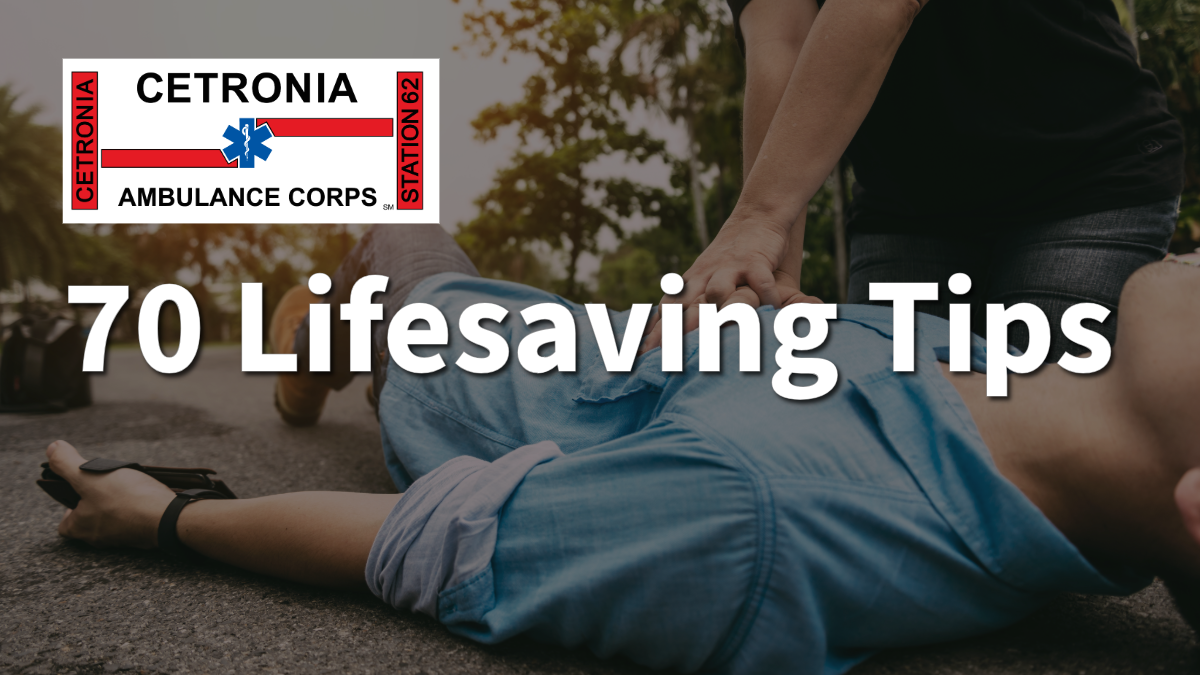
1. Hands‑Only CPR (Adults & Teens)
According to the American Heart Association, about 70 percent of out-of-hospital cardiac arrests happen in homes.
-
- Hands-Only CPR has just two easy steps, performed in this order:
- Call 911 if you see a teen or adult suddenly collapse
- Push hard and fast in the center of the chest to the beat of a familiar song that has 100 to 120 beats per minute
- Hands-Only CPR has just two easy steps, performed in this order:
2. How to Use an AED (Automated External Defibrillator)
According to the American Heart Association, CPR and AED use can double, or even triple, the person’s chance of survival.
-
- Follow these steps when using the AED:
- Turn on the AED and follow the voice prompts.
- Remove all clothing covering the chest. If necessary, wipe the chest dry.
- Peel away the backing from the pads and attach the pads to the person’s bare chest following the illustration on the pads.
- Plug the pads connector into the AED, if necessary.
- The AED will check to see if the person needs a shock and tell you when to give one. While the AED is analyzing, make sure no one is touching the person.
- Resume CPR if no shock is needed. If a shock is needed, make sure no one is touching the person and press the Shock button, and then immediately resume CPR.
- Continue CPR until emergency medical personnel arrive.
- Follow these steps when using the AED:
3. Know the signs of a stroke: BE FAST
-
- Balance: Sudden loss of balance or coordination
- Eyes: Blurred or double vision
- Face: One side droops when smiling
- Arms: One arm drifts downward
- Speech: Slurred or strange speech
- Time: Call 911 immediately
4. STOP THE BLEED: 3 Lifesaving Steps
Uncontrolled bleeding is the #1 preventable cause of death after injury. Learn how to save a life in under 60 seconds.
-
- 3 Core Steps
- Call 911
- Apply direct pressure with both hands using a clean cloth or gauze
- Use a tourniquet if needed – CALL 911
- 3 Core Steps
5. When and How to Use a Tourniquet
Use a tourniquet for life-threatening bleeding on arms or legs when direct pressure fails.
-
- How to apply a tourniquet:
- Place it 2-3 inches above the wound—never over a joint.
- Tighten until the bleeding stops completely.
- Note the time—it’s critical for medics.
- Don’t remove it until EMS takes over.
- How to apply a tourniquet:
6. Don’t move a person with a suspected spinal injury unless absolutely necessary.
7. Place an unresponsive but breathing person in the recovery position. Check for responsiveness for no more than 10 seconds.
“The recovery position is something that anyone can use and it’s a position that you can place a person or a patient in that helps you control their airway. When there’s risk of vomit or blood, any kind of fluid in the airway that could block it and become a severely life-threatening emergency, we place them on their side. So ideally, [it would be on] their left side. You place one arm up [so they can] lay their head on it to support them. Make sure that they’re facing out and they have space to let the vomit come out. You’re going to take your other hand and place it here against their face, like they’re sleeping on a pillow. And then you can bend one or both knees up to stabilize them. And this allows you to help monitor their airway. It can help you to make sure that when EMS gets there, they can do a patient assessment the way that they want to and reduces the risk of aspiration.”
~ Hannaford Bush, Fellow, Red Cross Scientific Advisory Council
8. Heimlich maneuver
A person who can’t cough, speak, or breathe needs immediate help. Ask if they are choking and let them know you will use abdominal thrusts, also known as the Heimlich maneuver, to prevent suffocation.
-
- Stand behind the victim with one leg forward between the victim’s legs
- For a child, move down to their level and keep your head to one side
- Reach around the abdomen and locate the navel
- Place the thumb side of your fist against the abdomen just above the navel
- Grasp your fist with your other hand and thrust inward and upward into the victim’s abdomen with quick jerks
- For a responsive pregnant victim, or any victim you cannot get your arms around or for whom abdominal thrusts are not effective, give chest thrusts from behind; avoid squeezing the ribs with your arms
- Continue thrusts until the victim expels the object or becomes unresponsive
- Even after choking stops, seek medical attention
9. If someone has a seizure, keep them safe and time the seizure—don’t restrain them.
10. If you suspect poisoning, call Poison Control immediately: 1-800-222-1222.
11. Keep a stocked first aid kit in your home, car, and workplace.
12. Use the RICE method for injuries
These steps can help reduce acute inflammation and pain in your soft tissues.
-
- Rest: Start the healing process.
- Ice: Recommended 10-minute intervals for pain relief and to help stop bleeding from trauma.
- Compression: Help control severe swelling
- Elevation: Slows blood flow to the injury
13. Treat burns with cool water, not ice or ointments.
14. Apply pressure to nosebleeds while leaning forward.
15. Clean cuts with water and cover with a clean bandage.
16. Don’t pop blisters—cover them and let them heal naturally.
17. Remove ticks with fine-tipped tweezers—don’t twist.
18. Know how to identify allergic reactions and administer epinephrine if needed.
19. Treat dehydration with water or oral rehydration salts.
20. Know fever guidelines, especially for infants and children.
A fever is a body temperature that is higher than normal. While the average normal body temperature is 98.6°F (37°C), a normal temperature range is between 97.5°F (36.4°C) and 99.5°F (37.5°C). Most pediatricians consider a temperature above 100.4°F (38°C) as a sign of a fever.
21. Install smoke detectors on every level of your home. Test them monthly.
22. For Fire Extinguishers, use the PASS method
-
- Pull: Pull the safety pin on the extinguisher.
- Aim: Aim the hose of the extinguisher at the base of the fire.
- Squeeze: Squeeze the handle to discharge the material.
- Sweep: Sweep the hose across the base of the fire from side to side.
23. Create and practice a fire escape plan with your household.
24. Never leave cooking unattended.
25. Keep space heaters three feet from anything flammable.
26. Replace frayed cords and don’t overload outlets.
27. Use flameless candles when possible.
28. Store matches and lighters out of children’s reach.
29. Don’t use water to put out a grease fire—smother it with a lid.
30. Know your local fire department’s non-emergency number.
31. Wear your seatbelt—every time.
Reminder: Pennsylvania’s Paul Miller’s Law, effective June 5, 2025, bans hand-held device use while driving.
32. Don’t drive under the influence of alcohol, drugs, or fatigue.
33. Check your tire pressure and brakes regularly.
34. Keep an emergency kit in your car.
35. Teach teens defensive driving and limit distractions.
36. Slow down in bad weather—posted speed limits are for ideal conditions.
37. Never leave children or pets in a hot car.
38. Install child car seats properly—get them inspected.
Read more to view local inspection stations with Certified Child Passenger Safety Technicians in the Lehigh Valley.
39. When biking, wear a helmet and follow traffic rules.
40. Install carbon monoxide detectors and test them regularly.
41. Keep medications locked away and dispose of them safely.
42. Secure heavy furniture to prevent tip-overs.
43. Store cleaning products out of children’s reach.
44. Keep emergency numbers posted near all phones.
45. Use night lights in hallways to prevent falls.
46. Install grab bars in bathrooms if anyone is mobility impaired.
47. Avoid running cords under rugs—they’re a fire hazard.
48. Clean your dryer vent regularly to prevent fires.
49. Have a disaster kit with water, food, flashlight, and meds.
50. Hydrate and take breaks during summer heat.
51. Apply sunscreen SPF 30+ and reapply every 2 hours.
52. Dress in layers in cold weather and watch for frostbite signs.
53. Don’t use ovens to heat your home.
54. Keep walkways clear of ice and snow.
55. Check for weather alerts before traveling.
56. Supervise children near pools or open water.
57. Use insect repellent with DEET to prevent mosquito-borne illnesses.
58. Wear long sleeves and tuck pants into socks in tick-prone areas.
59. Stay indoors during thunderstorms and avoid using wired electronics.
60. Know two ways out of every building you enter.
61. Sign up for local emergency alerts.
62. Take a certified first aid and CPR class.
-
- Cetronia Ambulance Corps offers monthly CPR Certification classes.
63. Keep emergency contacts in your phone and wallet.
64. Create a “go bag” for disasters with essentials.
65. Have an emergency meeting spot for your family.
66. Learn your workplace or school’s emergency plan.
67. Practice fire, tornado, or earthquake drills at home.
68. Make sure your house number is clearly visible for EMS.
69. Teach children how and when to dial 911.
70. Cetronia also offers a 70-song playlist to maintain the correct CPR pace (100–120 compressions/min)—including “Stayin’ Alive,” “Dancing Queen,” and many more.